
Oregon DOC Release Authority
The Oregon Department of Corrections runs Oregon's state-prison system. Its public records describe adults in custody, sentences, prison locations, planned release dates, and current community corrections cases. County sheriffs keep separate booking and release records for people who leave county jails. The Oregon DOC (ODOC) system therefore answers a state-prison question, not every question about a person who has left any jail in Oregon.
Agency identity matters because the public tool is named Oregon Offender Search, or OOS. The Oregon DOC home page is the official statewide starting point. Its corrections data can continue past a prison gate when a county Community Corrections office supervises parole, post-prison supervision, probation, leave, or local control. Physical release and full discharge are separate events.
The official DOC identity and statewide handoff can be seen on the agency's own site.
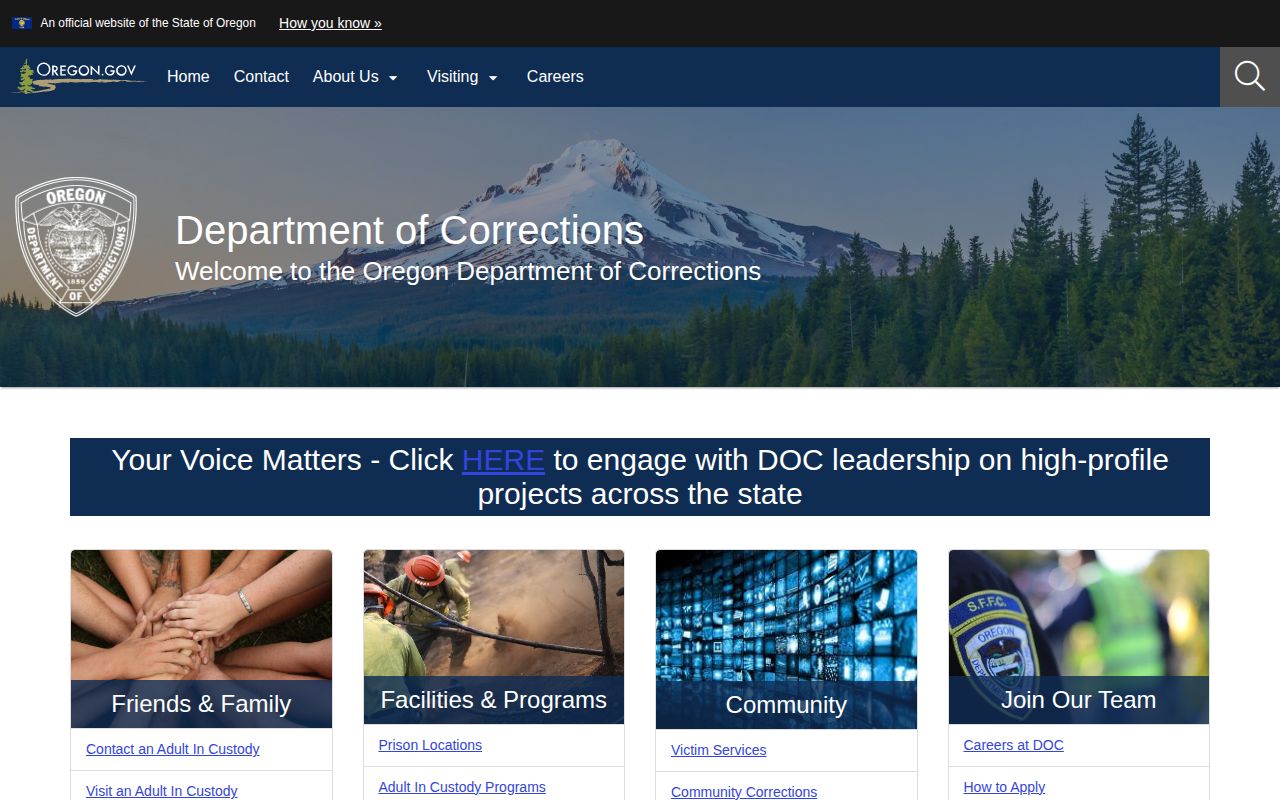
That page identifies the responsible state agency before a reader opens OOS, VISOR, or a records request.
Use the DOC Offender Search
Begin at the OOS landing page. DOC warns that the data are updated at intervals and should not replace an official record. Continue to the criteria screen and use the State Identification number, or SID, when known. A name search works too. OOS permits an asterisk inside or at the end of a name term, but not in a SID. Every field entered is combined, so one wrong extra detail can hide a valid match.
- Read the OOS notice, then open the search criteria screen.
- Enter the SID for the narrowest match, or enter first and last name.
- Sort the result list and select the linked SID for the detail record.
- Check the Names tab when an alias match displays a different Court Name.
- Read the data date, status, location, sentence fields, and projected release date together.
- Verify a release or discharge through the responsible agency record.
The official OOS name and SID form shows the two main ways into the search.
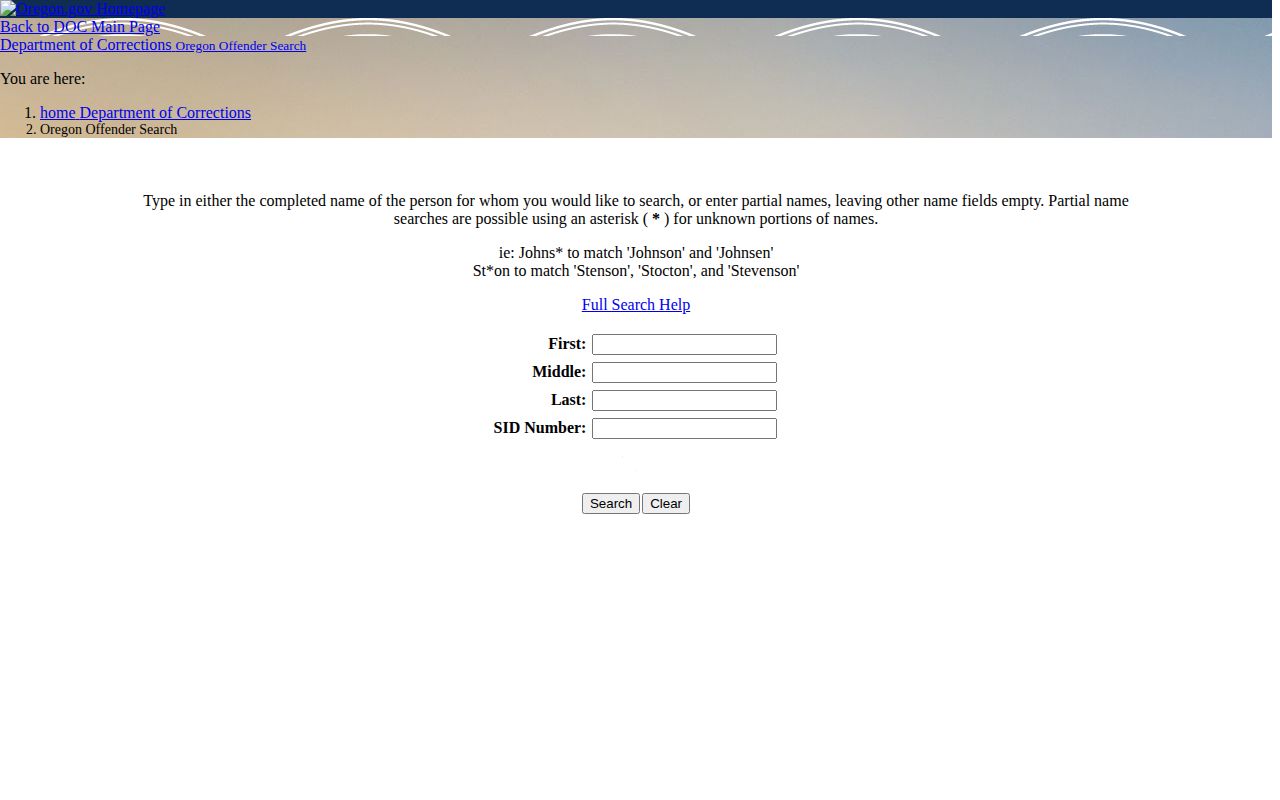
A SID match is stronger than a name alone, especially when several people share the same name.
Note: OOS shows only birth month and year, so compare the SID, names, status, and location before identifying a record.
Oregon DOC Search Result Fields
An OOS record must be read as a current corrections snapshot. The tool covers people now in DOC custody or under a local Community Corrections office. A community location may show that prison confinement ended while supervision continues. OOS does not promise a permanent result for a person whose full corrections obligation has ended. It also limits offense information to offenses linked with the current incarceration.
| Field | What It Establishes |
|---|---|
| SID | The Oregon State Identification number used to distinguish records. |
| Court Name and Names tab | The displayed court identity and aliases that may have produced the match. |
| Status and location | Whether the current record points to a prison or community-corrections setting. |
| Projected release date | A prospective DOC calculation, not proof that release occurred. |
| Sentence and offense data | Public information tied to the current incarceration, not a lifetime history. |
| Data-update notation | The timing context needed before relying on any displayed field. |
The OOS help page states the current-custody and current-supervision scope.
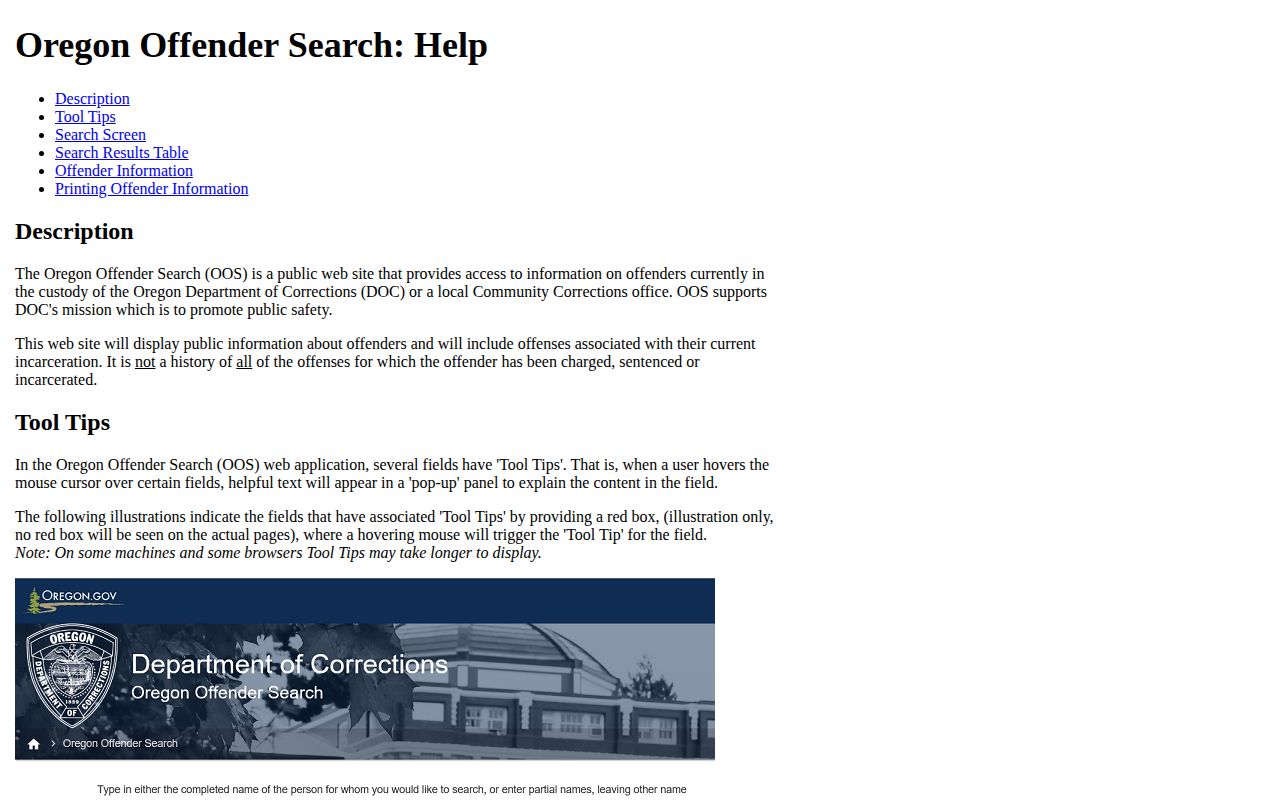
That narrow scope is why a missing result cannot, by itself, prove release or final discharge.
OOS Current Release Scope
A useful released-person result often describes someone released from physical prison custody who is still under community supervision. Oregon's community profile separates probation, post-prison supervision, parole, leave, local control, and other statuses. These terms must not be merged. Parole generally concerns Board authority in eligible cases. Post-prison supervision follows many modern prison sentences. Probation is ordered by a court, while leave and local control describe other active legal settings.
Important: No current OOS match means only that no current match was found. It does not certify release, discharge, or freedom from another agency's custody.
When a person disappears from OOS after supervision ends, use the official record path. A Board order, supervision order, DOC record, Pen Pack item, or sentencing-court record may establish the event. Do not create a “Discharged” status that the live system did not display.
The OOS disclaimer links public search use to the need for an official record.
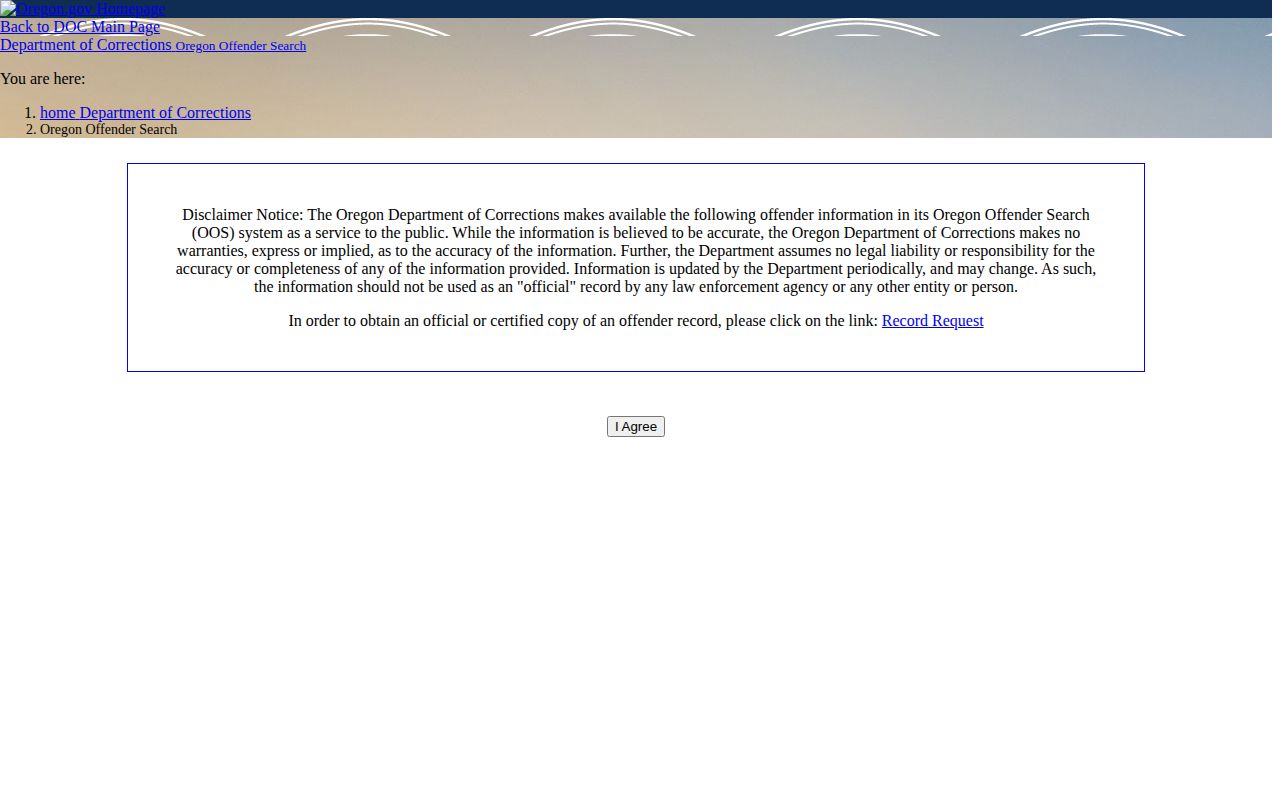
This warning keeps an online lead distinct from certified proof held by DOC.
Oregon DOC Release Paths
Several Oregon events are often shortened to “release,” although each has a different record trail. Physical DOC release ends confinement in a state prison. For many modern determinate sentences, post-prison supervision then begins through a county Community Corrections agency. In older indeterminate or other Board-governed cases, parole may start under Board authority. A person can thus be out of prison while still subject to reporting rules, conditions, sanctions, and a later supervision-expiration date.
Short-Term Transitional Leave, known as STTL, is another distinct path. DOC describes supervised leave of up to 30, 60, 90, or 120 days for eligible people under ORS 421.168, agency rules, and applicable legislation. Published eligibility includes a qualifying crime, an approved release placement, no detainers, minimum custody at release, clear conduct, and no level 1 or 2 misconduct report within 15 months of the projected date. Revocation may follow loss of that approved placement, a new crime, prohibited victim contact, continued noncompliance, or failure to report. STTL changes placement before the full sentence ends. It is not a discharge.
A detainer changes the route again. DOC defines it as an instruction to release a person to another jurisdiction's custody. The person may leave an Oregon institution on the computed date but go to a county, federal, immigration, or out-of-state custodian instead of the community. The DOC release record should identify the departure and receiving authority. Records from the next custodian then show what followed.
Final discharge is narrower than all of these events. It means the applicable custody or supervision obligation has ended. Evidence can include a Board action, an Order of Supervision expiration field, a DOC or Pen Pack record, a court termination order, or another official document. The right word follows the record: prison release, transitional leave, transfer, start of supervision, expiration, or discharge.
Oregon DOC Release Planning
Oregon publishes a staged release-planning countdown, but it does not promise one fixed gate-money payment or a standard bus ticket for every person. About six months before release, DOC describes pre-release programming and behavioral-health planning where needed. Four to six months out, a release counselor discusses transport, skills, county waivers, Interstate Compact issues, and the release plan. The counselor sends the plan to the Board and Community Corrections for their roles.
At 75 days or less, the counselor checks the field investigation, and a parole officer may conduct a reach-in visit. Around 30 days, benefits coordination may occur. In the final one to two weeks, the counselor verifies the projected date, finalizes transportation, and requests the person's own Central Trust funds. These are planning markers, not guarantees of a set cash grant, a set route, or a universal release hour. Person-specific details belong with the institution and release counselor.
Note: A detainer can direct DOC to transfer a person to another jurisdiction instead of releasing the person into the community.
Oregon DOC Earned-Time Limits
ORS 421.121 permits up to a 20 percent reduction of qualifying DOC incarceration terms for appropriate institutional behavior and adult basic-skills participation. “Up to” is essential. The statute excludes sentences governed by several listed mandatory or determinate provisions. Credits depend on the applicable sentence and conduct, not a flat statewide subtraction.
Measure 11 is a major limit. DOC explains that covered mandatory minimums for specified person offenses do not receive good-behavior reduction, subject to later statutory changes and limited exceptions. The judgment, offense date, conviction statute, and any applicable exception under Oregon sentencing law must be read together. Presentence credit, concurrent or consecutive terms, amended judgments, Board action, misconduct, detainers, and leave eligibility can also affect the calculation.
| Record | Role in the Date |
|---|---|
| OOS projection | The public snapshot of DOC's current calculation. |
| Court judgment | The legal terms, conviction provisions, and later amendments. |
| DOC computation | The person-specific administrative calculation and applied credits. |
| Actual release record | The event that shows whether the person left, transferred, or began supervision. |
Oregon DOC Release Flow
DOC's May 19, 2026 Quick Facts gives a dated view of the prison system. It reports 12 institutions, 12,124 adults in custody, and an average of 328 releases per month during April 30, 2025 through May 1, 2026. That monthly average would equal an annualized pace of 3,936 if multiplied by 12, but DOC did not publish it as an annual release total. County-jail, federal, and immigration releases are outside that figure.
The March 1, 2026 Community Population Profile reports 19,471 community cases: 9,607 in the post-prison group, 9,605 probation, and 259 local control. Its more detailed status labels include post-prison, probation, parole, leave, local control, and smaller groups. Quick Facts and the profile use different dates and definitions, so their nearby figures should be attributed, not forced into one supposedly corrected total.
Oregon DOC Discharge Proof
Actual prison release and supervision expiration are separate record fields. The Oregon Board of Parole's sample Order of Supervision distinguishes an actual release date from parole and post-prison-supervision expiration. A person can be outside prison yet remain under active authority. At the other end, the absence of an OOS record does not serve as a discharge certificate.
A DOC Pen Pack may contain public-information prints, face sheets, a photo, court or sentence orders, judgments, and, when present, parole-discharge material, revocation recommendations, or structured-violation sanctions. For probation, the sentencing court's register and terminating order are usually the better primary records. Ask for the exact record needed, including an actual release date, release authority or type, final face sheet, computation record, and any public discharge or supervision order.
Note: Request certification expressly when an ordinary copy will not meet the purpose for which the record is needed.
Oregon DOC Versus County Release
The DOC offender search is for the state corrections layer. A county-jail departure remains with the county sheriff or regional jail, even if a court case later connects to DOC. A transfer to DOC, ICE, federal custody, or another jail is a departure from one facility, not necessarily community release. Oregon's 36 counties also publish very different roster windows, from current-only lists to recent-release reports or no online history.
| Custody Layer | Primary Check | Historical Proof |
|---|---|---|
| Oregon prison | OOS and VISOR | DOC record or Pen Pack |
| County or regional jail | County roster, release report, or VISOR | Sheriff release record and court file |
| Federal prison | BOP Inmate Locator | BOP and federal court records |
| Immigration detention | ICE detainee locator | ICE field office and source-agency record |
Use the County Directory to reach the proper Oregon locality when the release began in a county jail. The statewide Facility Directory distinguishes DOC prisons, local jails, FCI Sheridan, youth sites, and closed facilities.
Request Oregon DOC Release Records
DOC now routes requests and messages through its GovQA Public Records Center, not the former public-record email addresses. A written request must give the requester's first and last name plus a mailing or email address. Identify the person by full name and SID when possible. Add a date range, institution, and a narrow list of records. Oregon Public Records Law allows exemptions and redactions, so a broad demand can take longer to review.
The DOC Public Records Center explains both the official request route and Pen Pack option.
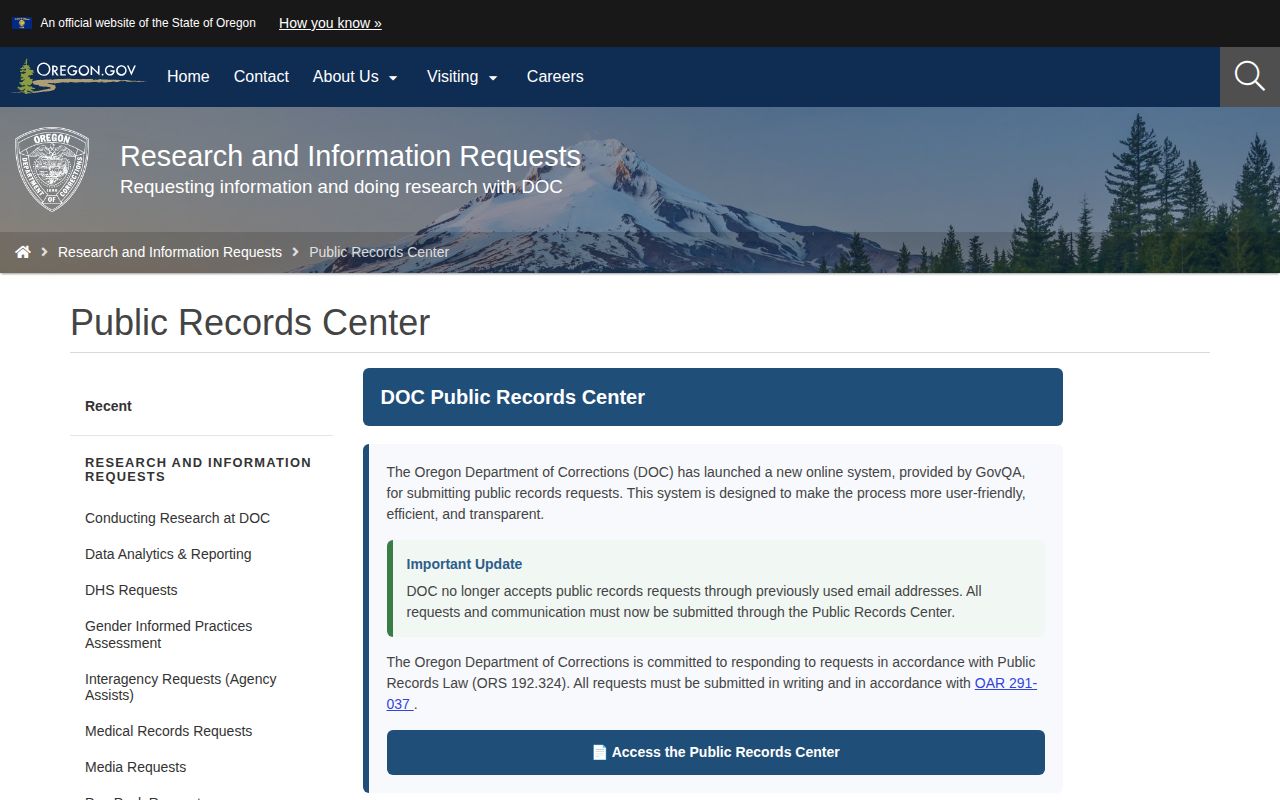
This is the key fallback when OOS no longer returns a current custody or supervision record.
DOC may clarify scope, search and review records, provide a fee estimate, then release nonexempt material after payment. The published schedule lists clerical time at $25 per hour, managerial time at $40, and professional time at $75, plus applicable copy, media, and postage costs. Recheck fees when filing. Ask for electronic delivery and an estimate when useful. The official record, not a saved search result, is the sound source for a historical release or completed discharge.
Frame the request around the event to reduce ambiguity. Give the full name, SID if known, date range, and institution. Ask separately for the projected date as calculated on a stated day, the actual departure date, the release authority or type, the destination or receiving custodian, and the supervision-expiration record if one exists. A request for “all records” is less precise and can increase search and review time.
Oregon Public Records Law, ORS 192.311 through 192.478, gives the general inspection framework but preserves exemptions. ORS 192.324 addresses agency handling and cost recovery, while ORS 192.329 concerns completion estimates. An acknowledgement is not the finished production. DOC may redact protected material or withhold an exempt record. If the needed document is a Board action or a court judgment, direct that part to the Board or filing court because DOC is not the custodian of every record connected with release.